
SJICD Quarterly Update - December 2025
Winter is settling over the San Juan Islands, and with it comes a moment to reflect. We are excited to share seasonal updates, reflections, and a look ahead.
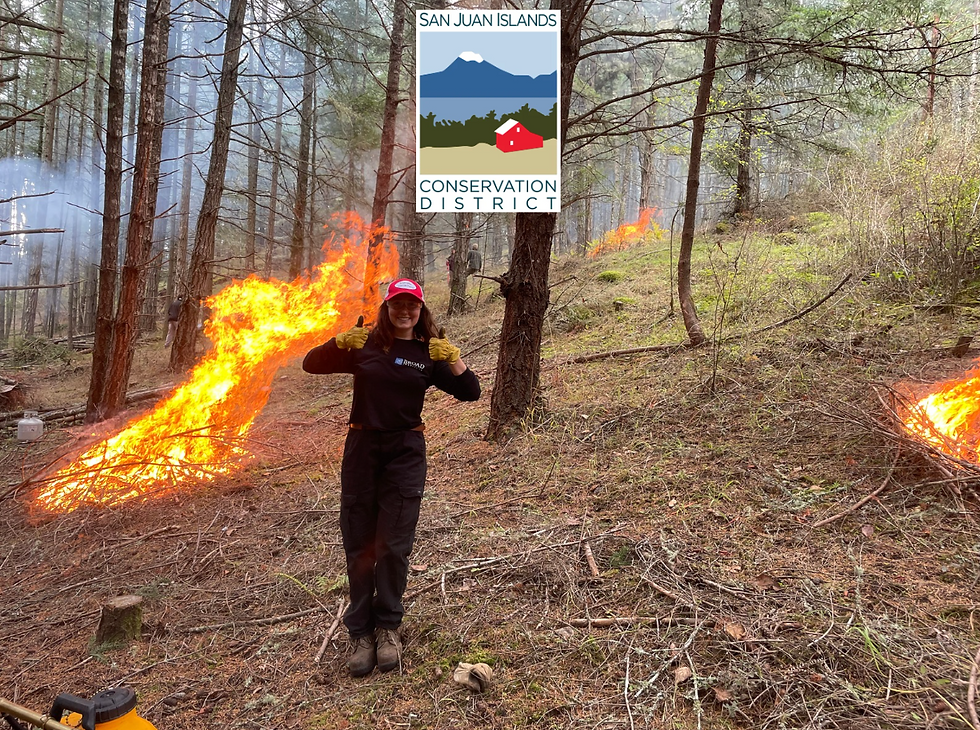
Each season’s passing is a fitting reminder of how conservation work transcends generations, and of how much we have accomplished. The brush piles burning down into biochar in the photo above were collected and built by crews of the Youth Conservation Corps (YCC) during our 2025 summer program. Throughout the fall they dried, and this winter are being transitioned with fire to a soil-healthy, carbon-storing charcoal by the elder Islands Conservation Corps crew.
Read on to learn more about:
Updates from the Youth Conservation Corps (YCC)– help us reach our $40k year-end fundraising goal and join our winter program!
How To: Responsible disposal of all your woody debris
New in 2026! Biochar kiln rental program and workshops
Eelgrass restoration milestones
Fun reading and listening, for the conservation minded
Upcoming events & opportunities
We’re hiring! Accepting Assistant Finance and Admin Manager applications now.
Youth Conservation Corps (YCC)
Since 2007, the Youth Conservation Corps has provided hands-on stewardship and skill-building opportunities for hundreds of youth in the islands. Historically supported by state and federal grant funding, the program now relies more on community contribution to remain accessible and fully resourced.
Help us raise $40,000 by year-end to ensure stipends, transportation, gear, and project materials remain fully supported in 2026 and beyond. Your generosity keeps our YCC crews going- and they’ve accomplished so much this past year! Check out the season end report, which includes the following notable highlights:

Registration is open for Winter YCC Programs on San Juan and Lopez Islands, providing opportunities for teens to build skills, connect with peers, and contribute to high-impact conservation projects during the colder season. Please forward this along to a 12-18 year old who would enjoy a YCC winter!
San Juan Island: In partnership with the Wolf Hollow Rehabilitation Center, a crew of 10 will work two weekend days a month from January through March, receiving a $25/day stipend. The crew will focus on planting native trees and reconstructing the fence on the deer enclosure. Each day will be coupled with an environmental education lesson.
Lopez Island: In partnership with the Lopez Island Family Resource Center, this program emphasizes field trips, learning, and exploration. (Since no hands-on conservation labor occurs, this program does not include a stipend).
Woody Debris Disposal: Burn Smart or Choose Cleaner Options
Are you dreading lighting those growing brush piles on fire again this year, tending them in the smoke all day? The Conservation District encourages landowners instead to take advantage of a clean, cheap alternative by bringing your brush to The Exchange on Orcas, or Midnight’s Farm on Lopez. Still need to burn? We are excited to launch a new biochar kiln rental and training program in 2026 (read on for details!).
Our forests generate huge amounts of woody debris, and winter storms often add to the pile, raising the perennial question: How should I dispose of all this material responsibly?
One of the most common disposal methods is slash pile burning. It’s simple, inexpensive, and under the correct seasonal regulations, can be effective. But what exactly comes out of those burns, and how can landowners reduce emissions?
Burning releases particulate matter and (PM₂.₅), CO, CH₄, VOCs, and greenhouse gases, but not all stages of combustion produce the same amounts. The smoldering phase – which is extended when burning wet fuels or piles with insufficient air circulation – produces the bulk of emissions. A dry, well-aerated pile burns hotter, cleaner, and faster, reducing emissions per ton of biomass.
Cleaner alternatives and best practices:
Compost woody debris on-site
Bring material to a local organics processor
If you must burn, burn smarter, not harder:
Use only dry natural wood
Keep piles small and oxygen-rich
Avoid conditions with no wind or high wind – pick winds that don’t impact nearby structures, neighbors, or other flammable materials.
Check burn restrictions and buy your burn permits via the San Juan County Fire Marshal
Fully extinguish piles before leaving – make sure your fire is “dead out” with no embers, smoke or heat remaining when you walk away.
Take a kiln burn workshop and consider renting a kiln from us
Low-Emission Kiln Burn Workshop

We’re excited to announce a series of low-emission kiln burn workshops in January and February where participants will learn how specialized kilns dramatically reduce emissions while producing biochar – a highly stable source of carbon and an excellent soil amendment. After attending a workshop, participants will be eligible to rent the kilns from us for use on their own properties.
Orcas Island: January 25th at JB Farms
San Juan Island: February 21st at Overmarsh Farm Commons
Lopez Island: February 22nd at Midnight’s Farm
Workshops are free to attend but pre-registration is required! Contact Maggie@sjicd.org with questions.
Eelgrass Restoration: A Record-Setting Year

Our eelgrass restoration efforts continued to grow in 2025, trying to establish proven techniques for large-scale restoration through seed harvest and planting.
This year was one of our most productive as we work to restore critical nearshore habitat that support salmon, forage fish, and countless marine species.
2025 Eelgrass Restoration by the Numbers:
100+ volunteers supported our efforts
61,800 eelgrass seeds planted
2,756 seedlings planted
2,511 flowering heads harvested for future restoration
In 2026, the program has plans to continue volunteer engagement opportunities, strengthen partnerships with marine research groups, and increasing the number of seeds planted. Get in touch with Volunteer Coordinator Sage (Sage@sjicd.org) if you’d like to get your hands in the water in the Spring.
Read about the importance of eelgrass conservation in curbing effects of climate change in this article by Reasons to Be Cheerful, featuring Program Manager, Mitch McCloskey.
What we’re reading:
Eager: The Surprising, Secret Life of Beavers and Why They Matter, by Ben Goldfarb
Our Islands Conservation Corps was recruited by the San Juan Preservation Trust to construct Beaver Dam Analogs on Orcas Island (watch a video here!). As research proves just how important beavers are, we are basing our approach to restoration on nature’s most important ecological engineers!
What we’re listening to:
This season features our own Forest Health Manager, Kai Hoffman-Krull, alongside Jayden Alp of Envisioning Labs, discussing FireLance—a real-time monitoring technology designed to detect hotspots and prevent prescribed fire re-ignition. The episode explores the emerging landscape of public-private-people partnerships (4Ps) in wildfire resilience, highlighting trust-building, shared stewardship, and cross-sector collaboration.
Upcoming Events & Opportunities
January- February 2026: Low-emission Kiln Burn Workshops- SJICD is leading a series of day-long workshops where participants learn how specialized kilns dramatically reduce emissions while producing biochar – a highly stable source of carbon and an excellent soil amendment. After attending a workshop, participants will be eligible to rent the kilns from us for use on their own properties.
Orcas Island: January 25th at JB Farms
San Juan Island: February 21st at Overmarsh Farm Commons
Lopez Island: February 22nd at Midnight’s Farm
February 27- 28: San Juan Island’s Agricultural Summit – early bird registration opens January 5. With the theme Growing Resilience, this year’s Summit will return to San Juan Island, bringing together farmers, food producers, land stewards, researchers, and community partners for two days of hands-on learning and connection.
February 10, 8-week course: WSU Coached Planning (virtual) – WSU Forestry’s flagship course teaches landowners how to assess trees, avoid insect and disease problems and attract wildlife. Participants are “coached” in writing their own simple forestry plan that can help them qualify and enroll in conservation project funding opportunities.
Now Hiring
We are seeking qualified candidates for the position of Assistant Finance and Administrative Manager to support our financial management, organizational effectiveness, and administrative operations. Please help us spread the word by sharing this opportunity within your networks.
Thank you for your continued support of conservation and restoration efforts in the San Juan Islands. To learn more about our programs and projects please visit our website: www.sanjuanislandscd.org


Comments